

Understanding Customer Churn as a Silent Signal of Brand Health and Loyalty.
Disclaimer.
This article is intended for educational and reflective purposes only. It explores churn as both a business metric and a storytelling metaphor, offering interpretive frameworks rather than prescriptive strategies.
The insights shared here should not be taken as financial, business, legal, or professional advice.
Readers are encouraged to adapt ideas to their own context and seek independent guidance before making business or operational decisions.
The views, opinions, thoughts and ideas expressed are those of the author only and are conceptual in nature.
This content has been crafted to inspire reflection on brand narrative, authenticity and legacy.
Any references to company or brand names are solely for illustrative purposes and do not imply endorsement, affiliation, or criticism by the author.
Article Summary.
In the landscape of modern marketing, churn is more than a tally of departed customers, it is a narrative signal, a silent storyteller revealing the fractures between brand promises and lived experiences.
Every cancellation, every disengaged client, every quiet departure is a chapter left unfinished, a reminder that stories can unravel when resonance fades.
By definition, churn (or customer attrition) is the rate at which customers stop doing business with a brand.
It occurs when people cancel subscriptions, abandon purchases, or disengage entirely. While it can never be eliminated, it can be reduced through trust, value, and meaningful customer experience.
This article reframes churn not as a sterile financial metric but as a storytelling phenomenon.
It exposes the gaps between what brands say and what customers feel, asking us to read churn as a diagnostic text, one that reveals whether a brand’s narrative is authentic, enduring, and worthy of loyalty.
Understanding churn matters because acquiring new customers is significantly harder and more expensive than retaining existing ones.
High churn erodes growth, weakens reputation, and signals deeper issues in customer experience.
Across 15 interconnected sections, this article explores churn as both measurement and metaphor: a vessel with cracks, a forgotten chapter, a mirror reflecting whether a brand’s story truly resonates.
From the mathematics that quantify departure to the emotional architecture that drives it, churn becomes a lens for diagnosing brand health, authenticity, and legacy.
Rather than prescribing tactics, I’m offering a framework for interpretation.
It shifts the question from “How many are left?” to “Why did they leave our story?”
In doing so, it challenges brands to consider whether they are merely building transactions, or crafting narratives that endure across time and generations.
Top 5 Takeaways.
1) Churn as Narrative Signal More than lost transactions, churn exposes misalignments between brand promises and customer experiences, serving as a diagnostic tool for authenticity and resonance.
2) The Emotional Architecture of Departure Customers leave not only for rational reasons but because they no longer feel seen, valued, or remembered—making churn a story of emotional disconnection.
3) The Leaky Bucket Paradox Brands often chase acquisition while neglecting retention, pouring resources into new customers even as existing ones slip away through unrepaired cracks in trust and experience.
4) Industry-Specific Narratives Churn manifests differently across sectors—subscription cancellations in SaaS, one-time disengagement in retail—but the underlying story of disconnection remains universal.
5) Legacy Beyond Metrics Ultimately, churn measures whether a brand’s story endures. It distinguishes between transactional loyalty (fragile, easily broken) and mythic loyalty (woven into identity, memory, and legacy).
Table of Contents.
1) The Cracked Vessel: An Opening Meditation.
2) Defining Churn in Marketing Terms.
3) The Mathematics of Churn.
4) Churn as a Brand Health Metric.
5) The Emotional Dimension of Churn.
6) The Leaky Bucket Metaphor.
7) Churn Across Industries.
8) The Psychology of Leaving.
9) Retention vs. Churn: Two Sides of the Same Story.
10) Churn as a Narrative Diagnostic.
11) The Cost of Churn.
12) Storytelling Strategies for Connection.
13) Churn in the Age of Attention.
14) Churn as a Legacy Metric.
15) Conclusion: From Numbers to Narratives.
16) Bibliography
1. The Cracked Vessel: An Opening Meditation.
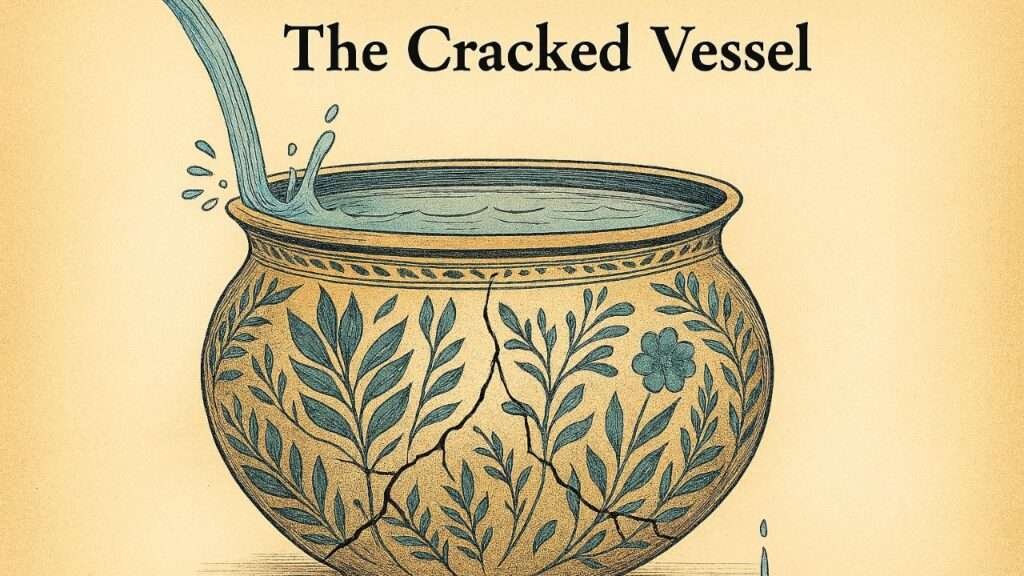
Imagine a beautifully crafted vessel, ceramic, perhaps, with intricate patterns that tell stories of the artisan’s hand.
Water flows into it continuously, a steady stream representing new connections, new relationships, new promises made.
Yet despite the constant influx, the vessel never fills. Instead, the water level remains strangely static, sometimes even declining.
Upon closer inspection, you discover the truth: hairline fractures spiderweb across the base, nearly invisible to the casual observer, yet relentlessly efficient in their erosion.
Each crack represents a broken promise, an unmet expectation, a moment when connection gave way to disconnection.
This is the phenomenon we call churn, though that clinical term barely captures the narrative weight of what’s actually occurring.
Churn is the silent storyteller of brands, the unseen force that reveals whether a brand’s mythology aligns with lived experience, whether its promises resonate beyond the initial transaction, whether its story is one that people want to remain part of over time.
The question I’m exploring with this article is I suppose deceptively simple yet profoundly complex: What does churn really reveal about a brand’s story?
Not just in terms of percentages or quarterly reports, but as a narrative signal, a way of reading whether a brand is creating meaning that endures or merely manufacturing moments that fade.
2. Defining Churn in Marketing Terms.

At its most fundamental level, churn is the rate at which customers end their relationship with a brand over a defined period.
In subscription models, it means canceling a service. In retail, it’s the one-time buyer who never returns.
In membership organizations, it appears as expired or un-renewed memberships.
The language matters. While churn and retention are mathematically inverse, if 80% of customers stay, 20% have churned, they tell different stories.
Retention highlights those who remain, who continue to believe in the brand’s narrative. Churn illuminates those who have left, who closed the book, who found the story unconvincing or the promises unfulfilled.
Churn operates on two levels. As a number, it quantifies departure. As a narrative lens, it reveals the deeper dimensions of brand health: trust, relevance, emotional connection and the alignment between promise and delivery.
This duality makes churn one of the most revealing measures of whether a brand’s story resonates in practice.
Unlike simple attrition, which may be circumstantial or passive, churn often reflects an active choice, a deliberate decision to disengage.
That choice transforms churn from a passive statistic into an active commentary on brand performance, making it one of the most honest feedback mechanisms available to organizations willing to listen.
3. The Mathematics of Churn.

While this exploration avoids financial guidance, understanding the basic mathematics of churn provides essential context for interpreting what the numbers reveal about brand narratives.
The Churn Rate standard formula is straightforward:
(Customers Lost During Period ÷ Customers at Start of Period) × 100.
For example, if a streaming service begins January with 10,000 subscribers and loses 500 by month’s end, the monthly churn rate is 5%. Simple enough, but the meaning of that number shifts dramatically across industries.
1) In SaaS, monthly churn of 3–5% may be acceptable for B2C products, while B2B enterprise solutions often aim for annual churn below 10%.
2) In e-commerce, churn is often measured as the percentage of first-time buyers who never return, a figure that can reach 60–80% depending on category and positioning.
3) In the wedding industry, churn is inevitable. A venue may deliver an unforgettable experience, yet the couple will likely never return as clients. Here, churn is not failure but transformation, into referrals, legacy and story-sharing that ripple outward.
These mathematical expressions of churn only gain meaning when placed in context.
The numbers themselves are neutral; their significance emerges from what they reveal about the relationship between brand promise and customer experience, between expectation and reality, between the story told and the story lived.
4. Churn as a Brand Health Metric.

Revenue loss is the most visible cost of churn, but focusing only on finances obscures a deeper truth: churn is a reflection of broken promises and unfulfilled expectations.
It is a diagnostic indicator of brand health that extends far beyond balance sheets. When customers depart, they vote with their attention, time, and resources. They signal that somewhere along the journey, the brand’s story no longer aligned with their lived experience.
Perhaps the product failed to deliver on its core promise. Perhaps the service created friction instead of flow. Perhaps the values so eloquently expressed in marketing proved hollow in practice.
This makes churn one of the most honest metrics of brand authenticity. Satisfaction surveys can be gamed.
Engagement metrics can be inflated. But churn represents revealed preference, the clearest expression of whether a brand’s story resonates strongly enough to sustain relationship.
Every gap in customer experience leaves a trace in churn: the on-boarding that confused instead of clarified, the service interaction that felt transactional instead of human, the product update that prized features over needs, the communication cadence that sounded like noise instead of value.
Each is a crack in the vessel, a fracture where narrative and experience failed to meet. Brands that see churn only as a revenue problem respond with surface-level tactics, discounts, incentives, win-back campaigns, that treat symptoms, not causes.
Brands that recognize churn as a health metric look deeper. They ask not just how to keep customers from leaving, but why they chose to leave the story in the first place.
5. The Emotional Dimension of Churn.

Beneath every churn statistic lies an emotional story. Customers rarely leave for purely rational reasons, despite what they might report in exit surveys.
The decision to end a relationship with a brand usually builds up over time, shaped by an accumulation of emotional micro‑moments: feeling unseen, undervalued, forgotten, or misunderstood.
This emotional dimension transforms churn from a transactional event into a narrative rupture. Consider the subscription box customer who cancels not because the products lack quality, but because each delivery has shifted from delight to intrusion—a reminder of another automated charge rather than a moment of discovery. The products remain excellent, but the emotional resonance has faded.
Or think of the retail customer drawn in by a compelling campaign, only to be buried under a flood of generic emails. They were never truly seen as an individual—just a data point, a target. Their departure isn’t about the product; it’s about the erosion of feeling known.
Viewed through this lens, churn becomes the “forgotten chapter” in a brand’s story—the moment when the myth that drew someone in no longer matches their lived reality. It is the gap between aspiration and experience, between the story told and the story lived.
The emotions that drive churn are powerful: disappointment when expectations go unmet, frustration when friction replaces flow, invisibility when customers feel like numbers, irrelevance when the brand evolves away from their needs, and betrayal when stated values collapse under scrutiny. These forces outweigh rational cost‑benefit calculations in shaping departure decisions.
5.1 How Churn Relates to the Broken Windows Theory.
To understand how emotional fractures accumulate, it helps to borrow a lens from outside marketing: the Broken Windows Theory.
Originally a criminological framework, it suggests that visible signs of neglect, like a single unrepaired window, signal abandonment and invite further disorder. Left unchecked, small cracks compound into systemic decline.
Churn behaves the same way. It rarely erupts from a single catastrophic failure. Instead, it builds through unattended emotional fractures in the customer journey.
A customer who feels unseen once may forgive it. Twice, they begin to doubt. By the third time, the relationship is already in decline. What begins as a minor disappointment, an unanswered email, a generic campaign, a delivery that feels transactional rather than delightful, escalates into a perception of neglect.
Once that perception becomes the dominant narrative, churn is no longer a possibility; it is inevitable. The Broken Windows Theory reminds us that customers are not tallying rational cost‑benefit equations in isolation.
They are reading the signals of care, attention, and respect embedded in every micro‑moment. A brand that fails to repair its “emotional broken windows” communicates indifference, even if unintentionally.
Over time, that indifference erodes trust, reshapes perception, and transforms loyal advocates into silent departures. Just as a neighborhood’s vitality depends on swift repair and visible stewardship, a brand’s longevity depends on vigilant emotional maintenance.
Preventing churn is less about last‑minute discounts or retention gimmicks and more about repairing the small cracks before they spread. Seen through this lens, churn is not simply a metric to be managed but a mirror reflecting the brand’s discipline in maintaining its own narrative integrity.
The lesson is clear: protect the small details and the larger relationship will endure. Neglect them, and the story collapses.
6. The Leaky Bucket Metaphor.

The leaky bucket is one of marketing’s most enduring metaphors, yet its implications bear repeated examination.
Imagine a brand as a bucket: marketing and acquisition efforts are the water flowing in from above, while churn is the holes that drain water out even as more pours in.
The mathematics reveal a troubling pattern across industries. Many brands pour disproportionate resources into acquisition (filling the bucket) while investing minimally in retention (repairing the leaks).
The result is a cycle where the brand runs faster and faster just to keep the water level steady, exhausting resources in the process.
This imbalance is not only financial but narrative. Acquisition costs often exceed retention costs by a factor of 5–25, yet budgets skew toward acquisition because growth numbers are visible, immediate, and exciting.
Retention, by contrast, feels like maintenance, less glamorous, harder to quantify, and easier to overlook.
But without retention, acquisition becomes an expensive treadmill that never truly moves the brand forward.
The leaky bucket metaphor poses a fundamental question: is it wiser to pour faster or to patch the vessel?
While both matter, brands that prioritize patching, addressing the root causes of churn and strengthening the integrity of customer relationships—often find that retention creates compound growth more efficiently than acquisition ever could.
Retained customers spend more over time, refer others more frequently, provide richer feedback, and cost less to serve as they grow familiar with products and processes.
They are not just preserved revenue but amplified value. In narrative terms, they evolve from readers of the brand’s story into co‑authors and advocates, spreading the story to others.
The leaks in the bucket, then, don’t just represent lost customers. They represent eroded advocacy, diminished amplification, and fading institutional knowledge about what makes the brand valuable.
Each leak weakens not only current revenue but future growth potential, making the pursuit of new customers increasingly costly as the base of advocates erodes.
7. Churn Across Industries.
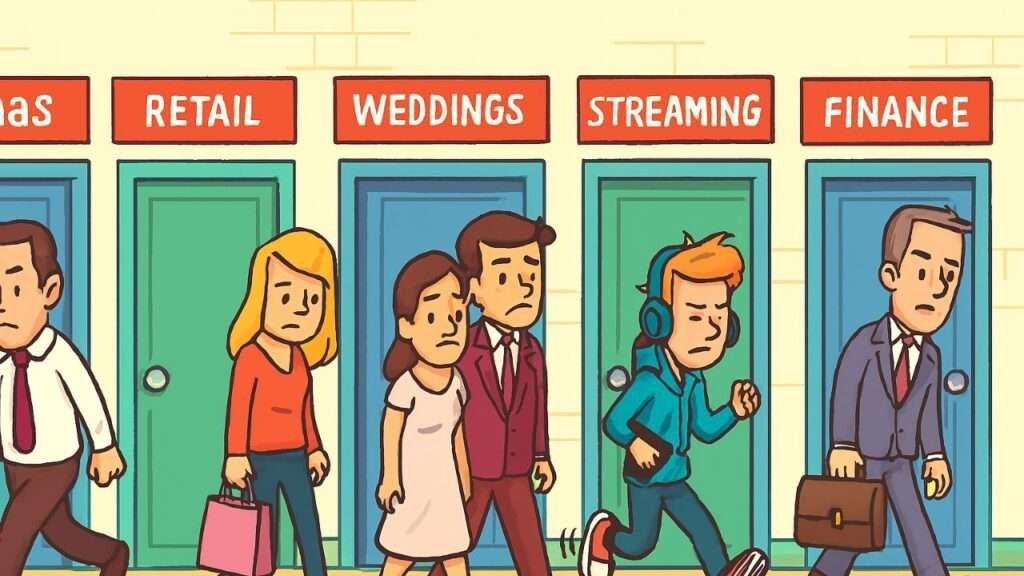
While the fundamental dynamics of churn remain consistent—customers leaving when expectations and experiences diverge—the manifestations vary across industries, each telling a distinct version of the disconnection story.
1) SaaS and Subscription Services: Churn often takes the form of silent cancellations, non‑renewals, or credit cards that “fail” and never get updated. Monthly churn rates become critical, with small differences (4% vs. 6%) compounding dramatically over time. The narrative here centers on value perception: does the ongoing cost justify the ongoing benefit? Subscription models create recurring decision points where customers continuously reevaluate the relationship.
2) Retail and E‑Commerce: Churn often appears as the one‑time buyer who never returns. There’s no formal cancellation, just absence. The brand may celebrate the acquisition, unaware the customer has already decided not to return. The story here is one of unmet expectations, where the product or experience failed to match the marketing promise.
3) Weddings and Life‑Milestone Events: In these industries, churn is built into the model. A couple who receives exceptional wedding services won’t need them again. Yet the story doesn’t end—it transforms into legacy: referrals, advocacy, and the stories they share. Here, churn is less about retention and more about ensuring the experience creates lasting positive memory.
4) Streaming and Media: The attention economy produces “subscription hopping,” where customers cancel and resubscribe multiple times, maintaining only a subset of services at once. The narrative battle is about memory and habit formation—can the brand become essential enough to maintain continuous presence in a crowded landscape?
5) Financial Services: Churn here is rarer due to switching costs and inertia. When it does occur, it signals deep dissatisfaction or a compelling alternative. The narrative often involves trust erosion, accumulated frustrations, or the sense that the institution no longer serves evolving needs.
Across all these contexts, churn tells a story of disconnection, though the chapters differ.
Recognizing industry‑specific churn patterns helps brands identify which disconnection stories are most likely to unfold—and where narrative repair can be most valuable.
8. The Psychology of Leaving.

The decision to leave a brand rarely happens in a single moment. It unfolds as a psychological journey across multiple touchpoints, each adding weight until a tipping point is reached.
Cognitive triggers play a central role. Unmet expectations create dissonance—the discomfort when reality contradicts belief. A customer who associates a brand with quality or innovation but encounters mediocrity begins to feel that tension. At first, they may rationalize the gap. Over time, repeated dissonance erodes trust and forces reevaluation.
Friction compounds the strain. Each difficulty—repeated service calls, confusing account interfaces, long hold times, irrelevant emails—adds psychological cost. Alone, these irritations may not cause departure. Together, they make staying feel heavier than leaving.
Belonging is perhaps the most powerful driver. Humans seek identity and community. When a brand fails to foster connection, when customers feel like transactions rather than participants, the bond weakens. This explains why some brands with nearly identical products retain customers more effectively: they’ve built belonging that transcends utility.
From this perspective, churn is a story of progressive disconnection:
1) Attraction: the promise aligns with need.
2) Honeymoon: early experiences exceed expectations.
3) Accumulation: small disappointments begin to stack.
4) Reevaluation: the customer questions the relationship’s value.
5) Exploration: alternatives start to look appealing.
6) Departure: the cost of staying outweighs the cost of leaving.
This journey explains why exit surveys often miss the truth. By the time a customer leaves, they are rarely inclined, or able to articulate the long emotional arc that led them there. They cite a trigger, but the real cause lies in months or years of accumulated distance.
It also explains why win‑back campaigns struggle. Once a customer has rationalized their departure, incentives alone rarely suffice.
Reconnection requires addressing the deeper psychological fractures—the dissonance, the friction, the absence of belonging, that drove them away in the first place.
9. Retention vs. Churn: Two Sides of the Same Story.
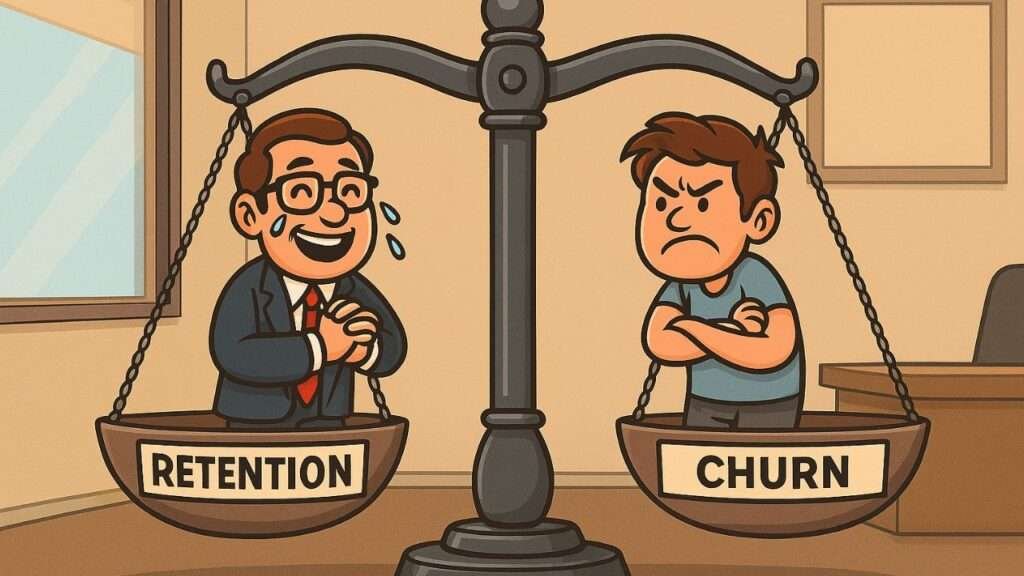
While mathematically inverse, retention and churn tell fundamentally different stories about brand relationships.
Retention speaks to loyalty, belief, and sustained value. Churn illuminates loss, disconnection, and narrative failure.
Viewed in isolation, each metric is incomplete; together, they provide dimensional insight into brand health.
1) Retention asks: Who stays, and why? It reveals the customers for whom the brand’s story continues to resonate, for whom the value proposition remains compelling, for whom the relationship delivers enough utility and meaning to endure. High retention suggests alignment between narrative and experience, robust value delivery, and effective community or habit formation.
2) Churn asks: Who leaves, and why? It exposes the customers for whom the story has lost resonance, for whom expectations diverged from reality, for whom the relationship no longer justifies its costs—financial, psychological, or temporal. High churn signals misalignment, value erosion, or competitive displacement.
Read together, these metrics reveal patterns that either alone might obscure.
A brand may appear stable, maintaining customer numbers, yet hide a leaky bucket of high churn offset by high acquisition.
Conversely, a brand with modest acquisition but exceptional retention may be compounding loyalty into sustainable growth.
The temporal dimension adds nuance. Early churn (departures within the first months) often signals onboarding failures, expectation gaps, or poor fit.
Late churn (long-tenured customers leaving) suggests misaligned evolution, competitive displacement, or accumulated dissatisfaction.
Each requires a different narrative investigation.
Cohort analysis deepens the story further. Customers acquired through certain channels may retain poorly, revealing messaging misalignment. Others who engage with specific features may retain exceptionally well, pointing to the brand’s true core value.
The relationship between retention and churn also reflects lifecycle stage. Early-stage brands focus on acquisition and initial retention to establish product-market fit.
Mature brands often find greater growth in incremental retention gains than in acquisition acceleration. The narrative shifts from attracting believers to maintaining faith.
Ultimately, both metrics answer the same question from different angles: Is the brand’s story compelling, authentic, and valuable enough to sustain ongoing relationships? Retention affirms when the answer is yes.
Churn tends to happen when and where the answer becomes no.
10. Churn as a Narrative Diagnostic.
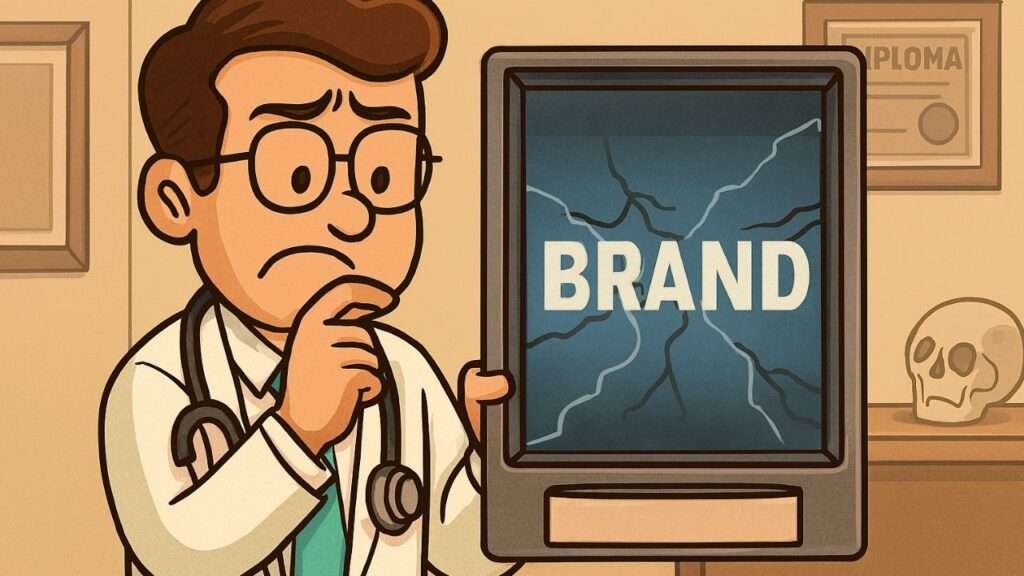
Beyond its role as a performance metric, churn serves as a diagnostic tool for assessing whether a brand’s core narrative, its myth, promise and identity truly resonates with its audience.
When significant churn occurs, especially among previously engaged customers, it signals potential narrative misalignment worth investigating.
Consider a brand positioned around sustainability and ethics.
If customers depart after discovering supply chain practices that contradict those values, churn diagnoses a failure of authenticity.
The brand’s story (sustainable, ethical) collides with the customer’s experience (questionable practices), creating dissonance that drives departure.
Or take a technology platform that promises simplicity. If churn clusters among users citing confusion and complexity, the signal is clear: the narrative promise (simple) diverges from experiential reality (complex).
Churn can also expose identity evolution. A brand that began serving a niche community may see elevated churn from that founding group as it expands to mainstream markets.
Whether this represents healthy growth or betrayal of core values requires careful judgment, but the churn itself is the diagnostic signal prompting that reflection.
Case studies illustrate this diagnostic power. When Netflix shifted from DVD rentals to streaming, churn spiked among customers who valued physical media.
That churn diagnosed narrative displacement: the company’s evolving story (streaming entertainment) no longer matched what some customers valued (DVD access). Netflix accepted this churn as the cost of evolution, but the signal itself was instructive.
Similarly, Snapchat’s controversial redesign triggered churn among core users. Leadership believed users wanted curated separation of content; users valued the chronological, mixed stream.
The churn diagnosed a narrative misunderstanding, ultimately prompting a partial rollback. Using churn diagnostically requires moving beyond surface numbers to uncover the stories within the data.
Segmenting churn by customer type, journey stage, product usage, or timing reveals which promises are failing and for whom.
Qualitative research, exit interviews, feedback analysis, journey mapping—adds depth, showing not just that churn occurred but why the story failed to hold.
The diagnostic value extends to competition. If churn concentrates among customers switching to specific rivals, it suggests those competitors tell more compelling stories or deliver more authentic experiences.
Rather than viewing this purely as market share loss, brands can read it diagnostically: What narrative or experiential advantage do they offer that ours does not?
11. The Cost of Churn.
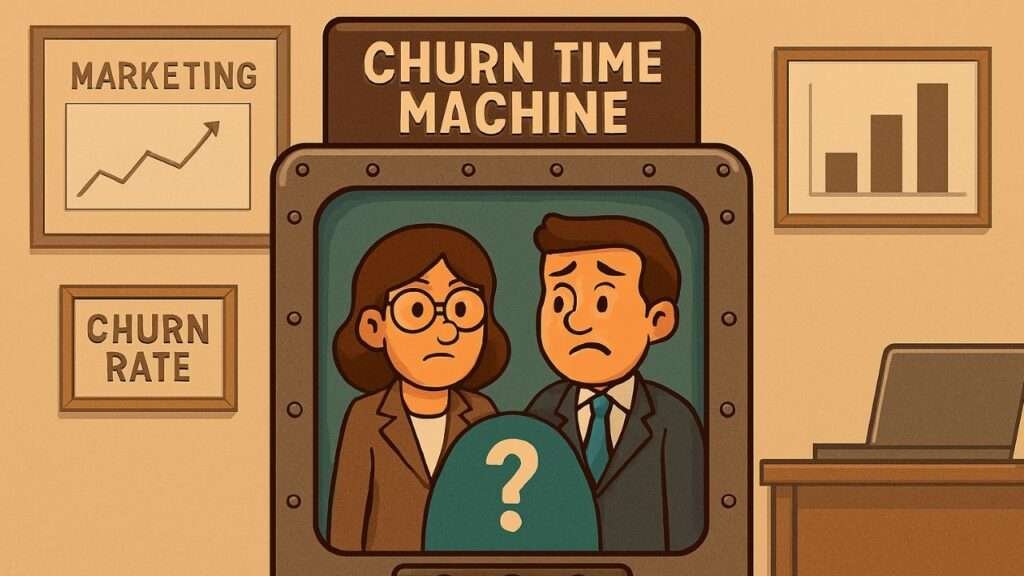
The financial costs of churn are well documented in business literature.
However, the narrative costs, lost advocates, broken trust and diminished legacy often prove equally significant, yet remain far less quantified.
These costs ripple outward like the butterfly effect: small departures today can compound into profound consequences tomorrow, shaping futures that brands will never fully see.
11.1 Lost Advocates.
Perhaps the most overlooked cost is the loss of advocates. Retained customers often evolve into storytellers for the brand, sharing experiences, recommending products, and defending the brand in social contexts.
When they churn, the brand loses not only their direct revenue but also their amplification effect. One advocate might have referred three others, who in turn might have referred three more.
The mathematics compound negatively: each departure silences a voice that could have multiplied the brand’s reach.
Worse still, churned customers rarely go silent, they often share their departure stories, creating negative word‑of‑mouth that actively repels potential customers.
11.2 Broken Trust.
Churn also erodes trust, not just with the departing customer but with the wider audience.
In an age of radical transparency, one publicized departure can echo across networks, damaging credibility.
Each churn event risks broadcasting a story of unfulfilled promises, creating headwinds for acquisition and sowing doubt among those who remain.
11.3 Diminished Legacy.
Brands build legacy through continuity, relationships that span years or even generations. Churn interrupts this thread.
A customer who leaves breaks the possibility of weaving the brand into their life story, and perhaps into their children’s.
Instead of becoming a chapter in a family narrative, the brand becomes a footnote. Over decades, high churn prevents the formation of generational loyalty, leaving competitors with deeper roots to dominate cultural memory.
11.4 Eroded Brand Memory.
Every churned customer represents someone who once believed in the brand’s promise, who once integrated it into their routines or identity.
Their departure diminishes cultural presence and weakens collective memory. Over time, this erosion reduces mindshare, making the brand less likely to be recalled, recommended, or chosen.
11.5 Lost Institutional Knowledge.
Long‑term customers accumulate knowledge of products, services, and values. They become efficient to serve, provide valuable feedback, and often act as informal support for newer customers.
When they churn, brands lose this accumulated intelligence and the informal advocacy that sustains communities.
11.6 Opportunity Cost: The Futures That Never Were.
Perhaps the most haunting cost of churn is the opportunity cost, the futures that vanish when a relationship ends prematurely.
A customer who leaves in year two might have become a decade‑long advocate, a premium subscriber, a co‑creator of new products, or a community leader. The brand will never know.
This is where churn resembles the paradoxes of time travel. We cannot step forward into the future to see what might have been had the relationship endured, then return to the present to act differently.
Each churn event is a fork in the narrative: one path leads to advocacy, legacy, and cultural memory; the other to silence, absence, and forgotten potential. The true cost of churn is not just what is lost today, but what will never come to be.
12. Storytelling Strategies for Connection.

Retention is not simply a matter of tactics; it is a matter of narrative craft.
Brands that sustain relationships do so by treating customer journeys as unfolding stories, with openings, middles, and continuations that reward attention.
What follows are not prescriptive rules but narrative patterns—ways stories tend to hold their audiences.
12.1 The First Chapter Matters.
Onboarding is the opening scene. Like any strong beginning, it sets context, builds intrigue, clarifies expectations and creates investment in what comes next. Brands that treat onboarding as mere administration miss the chance to establish narrative foundation.
Effective openings answer the arrival questions:
1) What happens next?
2) What can I expect?
3) How does this work?
4) Why did I make a good choice?
When these questions go unanswered, or worse, when customers are overwhelmed with irrelevant detail—friction takes root.
The first chapter should leave readers eager for the second, establishing rhythm, tone, and trust that the story will reward continued attention.
12.2 Keeping Readers in the Story.
Community sustains engagement beyond transactions. When customers connect with one another around shared experiences, the brand’s story becomes part of their identity.
Even modest gestures, spotlighting customers, showcasing user‑generated content, creating spaces for connection, signal belonging.
People remain with stories that feel communal, not transactional.
12.3 Inviting Co‑Authors.
Feedback loops transform customers from audience to participants. When input is sought, acknowledged, and acted upon, customers shift from passive readers to co‑authors. They see themselves in the narrative, not just as consumers but as contributors.
The key is consequence. Performative surveys or ignored suggestions erode trust. But when feedback shapes product evolution, policy, or community practice, customers develop ownership of the story. They become invested not only in what the brand offers but in where it is going.
12.4 Maintaining Narrative Consistency.
Trust is built when the story told matches the story lived. Each interaction should reinforce, not contradict, the brand’s promises.
Inconsistencies, claims of simplicity paired with complexity, or sustainability paired with questionable practices, create dissonance that accumulates into departure.
Consistency does not mean rigidity; it means coherence. The narrative must feel like one continuous thread, not a patchwork of contradictions.
12.5 Evolving the Story Without Losing the Plot.
Long‑term relationships require evolution. Brands that endure add chapters without losing the thread, introducing new elements without betraying core identity. Evolution that feels like natural progression deepens loyalty; evolution that feels like rupture accelerates churn.
The art lies in balance: refreshing the narrative while preserving its essence, so customers feel they are continuing the same story rather than being forced into a new one.
12.6 Writing the Ending Well.
Even endings matter. Not every customer will stay forever, but how a brand handles departures shapes memory and reputation.
A graceful offboarding—transparent communication, respectful closure, even an invitation to return—can turn a departure into a lingering goodwill story rather than a bitter one. In narrative terms, the final chapter can still affirm the integrity of the tale.
13. Churn in the Age of Attention.

The modern marketplace is defined by infinite choice and finite attention. In this environment, churn is not just more likely, it is more consequential, reshaping the very relationship between brands and audiences.
When options were scarce, switching costs, effort, uncertainty and availability created natural retention even when satisfaction was only moderate.
Today, the dynamic has reversed. Discovery requires almost no effort, switching carries little friction, and abundance means customers can constantly optimize for marginally better fit or value.
This creates what might be called loyalty fragility. Relationships that once endured through inertia now demand active value delivery and ongoing relevance.
The burden has shifted: brands must justify continued attention, not customers justify their loyalty.
In narrative terms, brands no longer compete only with direct rivals but with every other story vying for a place in memory.
Subscription fatigue illustrates this fragility. As customers accumulate services across categories, each subscription becomes not just a recurring cost but a recurring cognitive load, another login, another inbox, another obligation.
The weight of accumulation drives simplification, making even valuable services vulnerable during moments of pruning.
The paradox of choice compounds the risk. Abundance empowers preference matching but also creates constant alternative awareness. Customers know competitors are only a click away.
Every interaction becomes a retention test; any friction, disappointment, or unmet expectation sparks comparison and potential departure.
Memory itself becomes a retention factor. In an oversaturated environment, many brands are not abandoned out of dissatisfaction but simply forgotten — displaced by louder, more persistent voices.
To survive, brands must engage consistently, not to persuade, but to remain present in consciousness.
Social amplification raises the stakes further. Dissatisfaction that once ended in quiet departure now often becomes public testimony, magnified across networks.
Each lost customer can influence many others, while seeing peers leave normalizes departure.
Platform dependency adds another layer of vulnerability. Brands built on third‑party platforms live at the mercy of algorithms, policies, and migrations they cannot control.
Their story reaches customers only through intermediaries that may shift without warning.
Ultimately, churn in the age of attention reflects a fundamental power shift.
When attention was abundant and quality scarce, brands held the advantage.
Now, with quality abundant and attention scarce, power rests with customers, who can replace any brand that fails to continuously earn its place in their story.
In the age of attention, retention is no longer about holding customers, it is about holding their story.
14. Churn as a Legacy Metric.

Churn is more than a quarterly performance indicator. It is a measure of whether a brand’s story endures, across years, across generations and across culture itself.
At one level lies transactional loyalty: fragile, rational, and easily broken. Customers stay because the product delivers utility at acceptable cost.
This loyalty though, is vulnerable to marginally better alternatives, price shifts, or temporary dissatisfaction.
The brand occupies functional space, not emotional or identity space.
At a deeper level lies mythic loyalty: loyalty woven into identity, tradition, and memory.
Customers don’t just use the brand; they see themselves in it, pass it down, embed it in family stories. This loyalty withstands disappointment because it operates beyond utility, it lives in narrative.
Consider brands that span generations. Their endurance is not explained by features or price but by accumulated story: grandparents, parents and children sharing the same touchstone.
Low churn across decades creates the continuity necessary for mythic loyalty to take root.
This is why legacy metrics matter. Quarterly churn rates cannot answer questions like:
1) Will customers remember this brand in ten years?
2) Will they tell their children about it?
3) Will it live in cultural memory, or fade into forgotten alternatives?
High churn interrupts narrative continuity, preventing legacy from forming.
The mathematics are stark.
A brand retaining 95% of customers annually sustains continuity across decades. A brand retaining 75%, seemingly respectable, loses over 90% of a cohort within ten years, erasing the possibility of generational memory.
Brands with minimal churn become cultural reference points, appearing in art, literature, conversation, and collective memory.
Brands with high churn remain transient: widely used, quickly forgotten. They occupy space without leaving imprint.
This is the compound advantage of legacy. Thirty years of accumulated relationships, stories, and cultural presence cannot be replicated by new entrants, no matter their budget. Market share can be bought; generational memory cannot.
Viewing churn as a legacy metric reframes strategy. It shifts focus from short‑term optimization to long‑term stewardship.
It asks whether today’s decisions strengthen or weaken the chance for a brand’s story to outlast its leaders, its market cycles, even its era.
Churn is not just a number on a dashboard, it is the measure of whether a brand will be remembered, or forgotten.
15. Conclusion: From Numbers to Narratives.
Throughout this article, we have treated churn not merely as a financial metric but as a narrative phenomenon, a mirror reflecting truths brands may prefer to ignore but cannot afford to overlook.
The numbers matter, but what they reveal about the alignment between brand stories and customer experiences matters far more.
Churn illuminates the gap between promise and delivery, between the myth a brand tells and the reality its customers encounter.
It exposes whether marketing narratives harmonize with product experiences, whether stated values hold up in practice, and whether positioning resonates with actual needs.
Each departure is a signal, a story of misalignment, a vote of no confidence in the narrative being told.
The vessel metaphor with which we began remains apt. Brands are vessels attempting to hold relationships, trust, and loyalty.
The cracks, the sources of churn, may be nearly invisible at first, easy to dismiss while focusing on inflow.
Yet over time, those fractures widen, draining resources and preventing the accumulation necessary for growth, resilience and legacy. To understand churn as storytelling requires a shift in perspective: from the quantitative to the qualitative, from counting exits to interpreting their meaning.
The numbers provide signals, where churn concentrates, when it accelerates, which segments depart, but the deeper truth lies in asking why.
Which promises went unfulfilled? Which expectations diverged from reality? Which emotional connections eroded? Which narrative threads broke?
This investigative stance reframes churn not as failure but as feedback.
Every departure contains information, signals about brand health that, if interpreted with care, can guide refinement, renewal, and stronger connection with those who remain.
The brands that reduce churn most effectively are not those that mask it with discounts or gimmicks, but those that listen to what departures reveal and act on those lessons.
In today’s landscape of infinite choice, digital transparency, and scarce attention, understanding churn’s narrative dimension is no longer optional.
Loyalty cannot be assumed; it must be cultivated through consistent value, authentic alignment between story and experience, and genuine connection that transcends transactions.
Yet within this fragility lies opportunity. Brands that truly understand what their customers value, that deliver consistently on core promises, that create belonging and meaning beyond utility, can build relationships of remarkable resilience. In a world of shallow, transactional ties, deep connection becomes a sustainable advantage.
The question posed at the beginning, what does churn really reveal about a brand’s story? has a simple answer: everything.
Churn reveals whether a narrative resonates or rings hollow, whether promises prove authentic or aspirational, whether evolution feels like progression or betrayal, whether relationships deepen or dissolve.
The invitation, then, is to engage with churn not defensively but curiously. Not as a problem to be patched, but as a diagnostic to be investigated.
Instead of asking only “how many left?” brands might ask “why did they leave our story?” Instead of deploying retention mechanics without context, they might explore what narrative repairs could restore trust and strengthen connection.
Churn is a storyteller. It speaks in silence, in absence, in departures. Brands that learn to hear and interpret those silences gain access to one of the most honest forms of feedback available: the revealed preferences of those who chose to exit.
In the end, reducing churn is not about perfect products, flawless service, or aggressive retention tactics, though these may help.
It is about whether the story a brand tells is one people want to remain part of over time. Whether the narrative is compelling enough to carry relationships through imperfection, change, and challenge.
The brands that endure, the ones that build legacy, that weave themselves into cultural memory—are those that maintain narrative integrity long enough for shallow transactions to deepen into meaningful relationships.
They keep churn low not through manipulation, but through authentic delivery on promises, through seeing customers as people rather than metrics, through evolution that feels like growth rather than betrayal.
This is what churn reveals: whether a brand is building something that lasts or merely something that sells.
Whether it is creating meaning that endures or just moments that fade. Whether the story it tells is one that deserves continuation—and receives it.
For readers who wish to explore these themes further, several of my other articles expand on the mechanics and metaphors of churn:
1) The Hollow Frays in Branding – how brands unravel when substance is missing.
2) Marketing Funnels Strengths and Weaknesses and Marketing Funnel Alternatives and Complements – where structural leakage mirrors churn.
3) Improving Customer Connections – the antidote to attrition through visibility and resonance.
4) Maximizing CRM in Modern Marketing – technology as a tool for churn prevention.
5) Climbing Every Rung of the Brand Ladder – why missing steps cause customers to fall away.
6) Single and Parallel Value Propositions – how clarity of promise reduces churn risk.
7) Avoiding Single Points of Failure – resilience as a safeguard against systemic loss.
8) Marketing in a Depressed Market – churn under economic stress.
9) Marketing and Brand Building Highs and Lows – the emotional volatility that parallels churn cycles.
10) Know Your Audience – because misunderstanding your audience accelerates departure.
11) Clear Business Objectives, ADRI Framework for Small Business Marketing, and the 7×7 Step Marketing Framework – strategic anchors that prevent churn by aligning story, structure, and delivery.
12) Research-Based Marketing Solutions – how research uncovers churn signals before they become crises.
Together, I believe these articles form a constellation around churn, each offering a different lens on how stories fracture, how audiences drift, and how brands can repair, realign and endure.
16. Bibliography.

1.
“Customer Loyalty: How to Earn It, How to Keep
It” by Jill Griffin
2. “The Loyalty Leap:
Turning Customer Information into Customer Intimacy” by Bryan Pearson
3. “Brand Against the
Machine” by John Michael Morgan
4. “Customer
Centricity: Focus on the Right Customers for Strategic Advantage” by Peter
Fader
5. “The Power of
Customer Experience” by Martin Newman
6. “Building Brand
Authenticity” by Michael Beverland
7. “Marketing
Metrics: The Definitive Guide to Measuring Marketing Performance” by Paul
W. Farris et al.
8. “The Effortless
Experience: Conquering the New Battleground for Customer Loyalty” by
Matthew Dixon
9. “Data-Driven
Marketing: The 15 Metrics Everyone in Marketing Should Know” by Mark Jeffery
10. “Brand Seduction:
How Neuroscience Can Help Marketers Build Memorable Brands” by Daryl Weber
11. “The Customer
Culture Imperative” by Linden Brown
12. “Marketing 4.0:
Moving from Traditional to Digital” by Philip Kotler
13. “The Art of
Loyalty” by Raja Rajamannar
14. “Managing Brand
Equity” by David A. Aaker
15. “The Science of
Branding” by Matt Haig
16. Brand Churn: A
Significant Percentage of Customers Leaving by Aabhas Rana &
Rajesh Kumar Yadav
17. The Effects of
Brand Credibility on Customer Loyalty by J. Sweeney
18. How Brand
Loyalty Creates Enduring Profitable Growth
19. Customer
Experience, Loyalty, and Churn in Bundled Services by H. Ribeiro
20. A Meta-Model of
Customer Brand Loyalty and Its Antecedents by K. Desveaud
21. The Impact of Brand Image on Customer
Satisfaction and Loyalty by A.H. Tahir
22. Customer
Retention Strategies Forbes
23. Brand
Storytelling and Loyalty Adobe Blog
24. Customer Churn Analysis – What It Is
and How to Do It Woopra
25. The Psychology
Behind Customer Churn Harvard Business Review
26. Strategies to
Reduce Customer Churn in Subscription Businesses Chargebee
27. Brand Loyalty
Drivers in Competitive Markets McKinsey & Company
28. Understanding Customer Churn in SaaS
CXL
29. Customer
Retention Insights CustomerGauge






[…] are likened to water filling a bucket, while leaks symbolize the various issues that lead to customer churn, ineffective messaging, and poor […]