
Have Bolt-On Software Products Enhanced Our World?
Disclaimer.
This article is provided
for informational and strategic insight purposes only.
The views, opinions, ideas,
and interpretations expressed are solely those of the author and are shared in
the spirit of exploration, reflection and industry analysis.
They do not constitute
business, financial, legal, or investment advice.
Readers are encouraged to
conduct their own due diligence and consult qualified professionals before
making decisions related to software development, platform integration, or
ecosystem strategy.
All examples, case studies,
and references to companies or products are illustrative only.
They are used to highlight
market dynamics and do not imply endorsement, affiliation, or critique of any
specific organization, platform, or solution.
Technology landscapes
evolve rapidly, and the accuracy of product features, certification
requirements and integration capabilities may change over time.
Information presented here
may not be 100% current at the time of reading.
This content is intended to
provoke strategic thinking, not prescribe specific actions.
Article Summary.
This article explores bolt-on
software products, a term long used to describe integrated tools within larger
platforms and their evolving role in ecosystem strategy. These specialized solutions are no longer
peripheral, they are essential drivers of innovation, customer satisfaction and
ecosystem value.
This article explores how
bolt-ons have evolved from niche ‘gap filing’ solutions into indispensable
components of enterprise workflows and how their journey reflects broader
truths about brand strategy, product‑market fit and platform orchestration.
We examine the intentional
and emergent paths bolt-ons take, the certification gauntlet they must
navigate, and the strategic decisions around brand identity and marketing.
I’ll also map out bolt-on
opportunities across high‑value industries, from finance and superannuation to
healthcare and construction, revealing a hidden economy of integration that
powers modern business operations.
Finally, we’ll look ahead
to the rise of AI as the ultimate
bolt-on and the emergence of agentic browsers like BrowserOS and Perplexity Comet,
which signal a future where bolt-ons don’t just extend platforms, they redefine
them.
For software creators,
platform owners, and strategic marketers alike, understanding the bolt-on
lifecycle and the ecosystem it shapes, is key to building products that don’t
just plug in, but stand out.
Top 5 Takeaways.
1. Bolt-Ons Are
Strategic, Not Supplementary: The most successful bolt-ons solve specific
problems exceptionally well, becoming indispensable within larger ecosystems.
2. Integration Is a
Brand Strategy: Certification, UX alignment, and co‑marketing with
platforms elevate bolt-ons from tools to trusted ecosystem players.
3. Industry-Specific
Opportunities Are Vast: From banking to healthcare, bolt-ons thrive
by addressing specialized needs that core platforms cannot fully solve.
4. The Adoption Curve
Is Predictable: Bolt-ons move from early traction to essential
infrastructure through deliberate refinement and strategic positioning.
5. AI and Agentic
Browsers Redefine the Endgame: As AI evolves into infrastructure and agentic
browsers orchestrate ecosystems, bolt-ons are no longer just acquisition
targets, they’re the scaffolding of the digital future.
Table of Contents.
1.0 The Quiet Power Of Bolt-On Software.
2.0 The Bolt-On Economy Is A Market Hiding in Plain Sight.
3.0 Intentional vs Emergent Bolt-Ons.
4.0 Why OEMs
Possibly Can’t Keep Up.
5.0 The Marketing and Brand Implications.
6.0 Case Studies: Bolt-Ons in Action.
7.0 The Platform Perspective: Why OEMs Might Need
Bolt-Ons.
8.0 The Bolt-On
Lifecycle: From Add-On to Essential.
9.0 Strategic Implications for Product Teams.
10.0 Risks, Trade-Offs, and the Limits of Bolt-Ons.
11.0 Practical Resonance: Why This Matters to Real
People.
12.0 Is AI The Ultimate Bolt-On?
13.0 Agentic Browsers: The New Meta-Platform.
14.0 Conclusion: Scratching An Itch, Building A Future.
15.0 Bibliography.
16.0 Glossary Of Terms And Abbreviations Used.
1.0 The Quiet Power Of Bolt-On Software.

Every business has that one software product, the operational anchor where teams spend most of their day, where critical data lives and where workflows begin and end. It’s the backbone of how work gets done.
But even the best platforms have blind spots. Users often find themselves thinking, “If only it could track our custom workflow better,” or “If only it could generate reports the way we actually need them.”
That gap between what the core platform does well and what the business truly needs is where bolt-ons quietly enter the picture.
On the other side of that gap are niche software products, small, focused and remarkably specific.
Many of today’s most successful software brands likely began this way: not as platforms, but as tools built to solve one problem exceptionally well.
Was that always the plan? Or did customer demand pull them into the spotlight?
These gap-fillers fascinate me.
Especially now, when they can integrate seamlessly with massive platforms, becoming invisible extensions of the core experience.
Their strength lies in precision. They don’t try to do everything, they master one thing. That’s what makes them powerful bolt-ons.
But what happens when a bolt-on becomes indispensable?
When it’s no longer just useful, but essential?
What causes that shift, from helpful add-on to ecosystem anchor?
Is it strategic design, market timing, or relentless customer focus?
That’s the journey we’re about to explore.
This article unpacks the lifecycle of bolt-on software: how it starts, how it scales, and how it earns its place in the ecosystem.
Think of it like a three-season arc—an origin story, a rise to relevance, and a transformation into brand essential.
Let’s dive in.
2.0 The Bolt-On Economy Is A Market Hiding in Plain Sight.

Bolt-on software isn’t a fringe concept, it’s a foundational force in the global software economy/ecosystem.
These specialized tools quietly power the workflows that core platforms can’t fully address, bridging gaps with precision and speed.
Think of bolt-ons as the connective tissue between systems.
Your CRM might manage customer relationships, but it doesn’t automate billing.
Your e-commerce platform might handle transactions, but it struggles with inventory forecasting.
Your ERP might handle maintenance and production operations very well, but it lacks predictive maintenance.
Bolt-ons step in, the don’t compete, they compliment and complete.
Entire ecosystems have emerged around this dynamic.
Salesforce AppExchange hosts thousands of apps that extend CRM functionality. Shopify’s App Store enables merchants to scale from startup to enterprise.
HubSpot, Microsoft, Google Workspace, all have marketplaces where bolt-ons thrive. These aren’t side projects, they’re billion-dollar ecosystems where niche tools become essential infrastructure.
Some of the most successful software companies began as bolt-ons. Zapier didn’t try to replace platforms, it connected them.
Figma plugins didn’t rebuild design tools, they enhanced them. Supermetrics didn’t invent analytics—they made it accessible across platforms.
This is the bolt-on economy: a vast, decentralized network of specialized solutions that elevate core platforms by doing what they can’t. It’s not peripheral—it’s pivotal. And for developers, strategists, and platform owners, recognizing its scale is the first step toward building products that integrate, differentiate, and dominate.
3.0 Intentional vs Emergent Bolt-Ons.

Not all bolt-ons are born the same. Some are forged with integration in mind from day one. Others stumble into ecosystem relevance through customer demand and organic evolution.
Understanding these two paths—intentional and emergent—reveals how bolt-ons earn their place in the software world.
Intentional bolt-ons are built with a clear target: integration with a dominant platform. Their creators study the APIs, design the UX to feel native, and align their go-to-market strategy with the platform’s ecosystem. These products are ecosystem-first by design. They don’t just plug in—they belong.
Emergent bolt-ons, by contrast, begin as standalone solutions. They solve a specific problem brilliantly, often without any initial thought of integration. But as adoption grows, customers start asking: “Can this sync with our CRM?” “Can it push data into our ERP?” Integration becomes a necessity, not a strategy. The product evolves into a bolt-on because the market pulls it there.
Take Calendly. It started as a simple scheduling tool. Only later did it integrate with CRMs, video conferencing platforms, and payment systems—because users demanded it.
Or Grammarly, which began as a writing assistant and grew into an enterprise communication layer embedded across email clients, document editors, and collaboration platforms.
Both paths are valid. Both can lead to ecosystem indispensability. The difference lies in origin story: one begins with platform alignment, the other with product-market fit.
In the end, what matters most is execution—how well the bolt-on solves a real problem, integrates seamlessly, and earns trust within the ecosystem it serves.
4.0 Why OEMs Possibly Can’t Keep Up.

The reason I think platform vendors might struggle to match bolt-on innovation isn’t technical—it’s structural. It’s not that they can’t build what bolt-ons offer.
It’s more that they might not be designed to move that fast. That’s not a flaw or a failing, it’s just the reality of their operating model, as I see it.
Platform OEMs live under what I’d call the stability paradox.
Their core customers—large enterprises with thousands of users and mission-critical operations—demand reliability above all else.
It’s easy to understand why. Picture this: it’s 4:50 p.m., you’ve nearly wrapped up everything the boss had planned for the day, and suddenly, ‘The Dreaded Blue Screen’. Catastrophic system failure.
That’s not just frustrating, it’s operationally devastating. In environments like these, reliability isn’t a feature. It’s everything.
A large CMMS, ERP, or asset management platform serving millions can’t afford to roll out experimental features that risk downtime.
Stability, security, and backward compatibility aren’t optional, they’re non-negotiable.
That means innovation must move slowly, deliberately, and safely.
Bolt-on vendors live in a different world. Their products often serve narrower use cases—specific teams, workflows, or functions.
A predictive maintenance bolt-on, for example, might only touch the reliability engineering group.
That limited scope allows for faster iteration, more experimental features and greater tolerance for change. If something breaks, the integration might go offline, but the core platform keeps humming. The business can “keep on keeping on.”
This differential risk profile is what enables bolt-ons to innovate faster, deeper, and more responsively.
Then there’s the resource allocation challenge. Platform vendors must spread their development efforts across a vast terrain: workflow engines, mobile access, inventory, procurement, compliance, reporting, user management, and more.
Bolt-on vendors, by contrast, go deep on one domain.
A predictive maintenance company might employ more data scientists than the entire ERP team at a platform vendor. That focus breeds depth and a good depth wins in specialized domains.
Market dynamics reinforce this divide. When new technologies emerge, machine learning frameworks, IoT protocols, mobile-first UX, platform vendors must ask: Is this worth the investment? Will it benefit enough of our customer base?
Bolt-ons don’t wait. They move. They build. They test. And often, they lead.
Ironically, platform vendors need bolt-ons to stay competitive—even though bolt-ons highlight their limitations.
IBM’s Maximo Health and Predict is a bolt-on built by IBM itself. SAP’s Asset Intelligence Network adds lifecycle visibility beyond core SAP EAM.
Infor offers industry-specific EAM extensions. These aren’t signs of weakness—they’re acknowledgments that no platform can do it all.
This creates a delicate balance. Platforms want rich ecosystems because they increase customer stickiness.
A user deeply invested in multiple bolt-ons is far less likely to switch platforms. But promote bolt-ons too aggressively, and you risk admitting that the core platform isn’t complete.
The most sophisticated OEMs resolve this tension by shifting their identity—from comprehensive solution provider to ecosystem orchestrator.
They stop trying to build everything and start enabling everything. In doing so, they turn bolt-ons from competitors into collaborators and from add-ons into assets.
5.0 The Marketing and Brand Implications.

The rise of bolt-on software doesn’t just reshape product strategy—it rewrites the rules of marketing and brand positioning.
For both platform OEMs and bolt-on creators, the ecosystem dynamic introduces a new kind of identity challenge:
How do you market your value when your product is only part of a larger whole?
5.1 For Platform OEMs: From Monolith to Orchestrator.
For platform vendors, the shift is subtle but profound. The old model said: “We do it all.” The new model says: “We enable it all.”
Leading platforms like Salesforce, SAP, and IBM have embraced this shift by positioning themselves not as all-in-one solutions, but as ecosystem orchestrators.
Their messaging emphasizes openness, flexibility, and customer choice. They don’t shy away from the fact that bolt-ons exist—they celebrate it.
Take IBM’s Maximo Application Suite. It doesn’t just offer IBM-built extensions like Maximo Health and Predict—it also curates third-party integrations through its marketplace.
SAP’s Intelligent Asset Management platform promotes both proprietary and partner-built solutions.
Oracle’s EAM ecosystem balances internal bolt-ons with external innovation.
But this positioning only works if it’s authentic.
If APIs are limited, if partner apps are buried, or if vendor-built bolt-ons get preferential treatment, the “open platform” message rings hollow.
True ecosystem leadership requires genuine neutrality, technical openness, and marketing generosity.
The reward? Platforms that get this right become gravitational hubs.
They attract developers, retain customers, and grow faster, not by doing everything themselves, but by enabling others to do what they can’t.
5.2 For Bolt-On Creators: The Specialist Advantage.
For bolt-on vendors, the challenge is different: how do you position yourself as essential without undermining the platform you extend?
The answer lies in respectful differentiation. The best bolt-ons don’t compete with the platform—they complete it.
They acknowledge the platform’s strengths, then highlight the specific problem they solve better than anyone else.
Take BlackLine, which automates financial close processes. Their messaging doesn’t diminish SAP or Oracle—it complements them.
“Your ERP is powerful,” they imply. “We make it faster, cleaner, and more compliant.” Or Kyriba, which positions itself as the go-to treasury management layer for CFOs using NetSuite or SAP.
The most effective bolt-on brands lean into three pillars:
1. Depth over breadth: They master one domain instead of spreading thin.
2. Measurable ROI: They speak in outcomes, not features.
3. Integration excellence: They make adoption feel seamless, not risky.
As bolt-ons scale, the temptation to expand horizontally grows. But the smartest ones resist.
They deepen their niche, entrench their value and become so embedded that platform vendors either acquire them, or build around them.
5.3 The Composable Enterprise Message.
Both OEMs and bolt-on vendors increasingly rally around a shared narrative: the composable enterprise.
It’s the idea that businesses should assemble best-of-breed tools through standardized integrations, rather than settle for monolithic suites that do everything just okay.
But this message only works if the execution backs it up.
API-first architecture, prebuilt connectors, clear documentation, and proven implementation patterns must support the story.
When they do, the composable message becomes a brand differentiator.
When they don’t, it becomes a broken promise.
6.0 Case Studies: Bolt-Ons in Action.
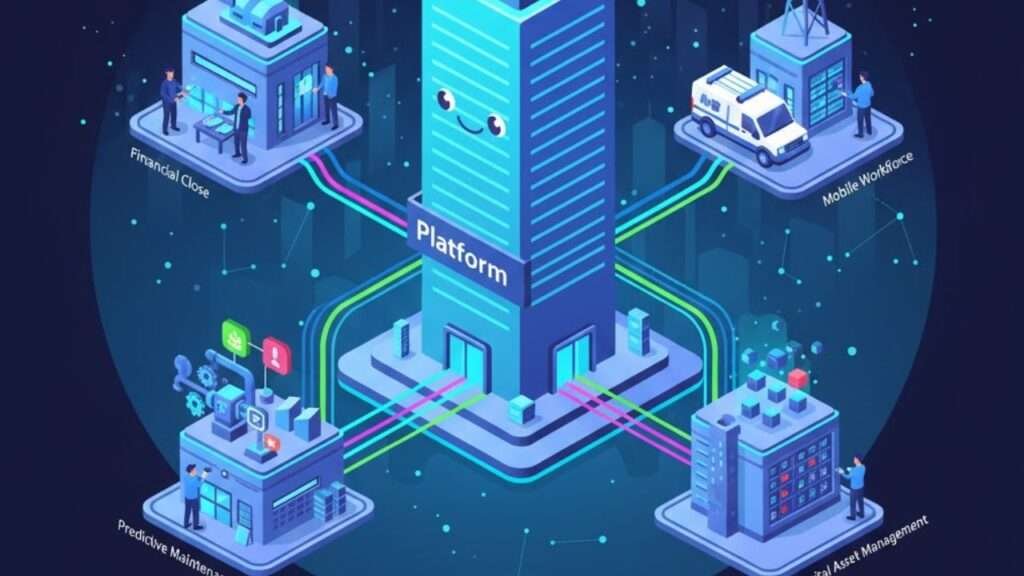
To understand the true power of bolt-ons, we need to look beyond theory and into practice. Across industries and functions, bolt-ons have quietly transformed how businesses operate—not by replacing core platforms, but by making them better.
6.1 Financial Close and ERP Extensions.
Take BlackLine, for example. It integrates with ERP systems like SAP, Oracle, and NetSuite to automate financial close processes, reconciling accounts, validating journal entries and certifying financial statements.
These are tasks that ERPs technically support, but often leave to manual effort.
With BlackLine, companies report dramatic improvements: faster close cycles, fewer errors, and stronger audit trails.
One manufacturing CFO put it plainly: “Manual close processes weren’t sustainable. BlackLine freed our team to focus on analysis, not reconciliation.”
Similarly, Kyriba extends ERP functionality into treasury and liquidity management.
CFOs gain real-time cash visibility, FX risk control and debt tracking, all while staying anchored to their ERP data.
These bolt-ons don’t compete with the ERP, they complete it.
6.2 Predictive Maintenance and AI.
When Siemens acquired Senseye in 2022, it wasn’t just a product move—it was an ecosystem play. Senseye had built AI-driven predictive maintenance tools that integrated with various CMMS platforms, helping companies reduce unplanned downtime by up to 50%.
Before the acquisition, Senseye operated as a bolt-on—an external specialist solving a problem that core platforms couldn’t. Post-acquisition, it became part of Siemens’ Digital Industries portfolio, proving that bolt-ons can evolve into strategic infrastructure.
Other examples include Fiix Foresight and Oracle Predictive Maintenance Cloud, platform-built bolt-ons that apply machine learning to sensor data and maintenance history.
These tools don’t just track what happened, they predict what’s about to fail.
6.3 Mobile Workforce and Field Applications.
Field technicians often struggle with desktop-centric interfaces retrofitted for mobile use.
That’s where ProntoForms shines. Integrated with platforms like Maximo, SAP, and Oracle, it offers mobile-first inspection tools with offline capability, photo capture, and voice notes.
The results are tangible. Rambler Metals & Mining increased wrench time by 15% in just 90 days.
Maintenance teams using mobile-first bolt-ons report up to 27% reductions in asset-related downtime.
The core system stays intact but the field experience becomes frictionless.
6.4 IoT Integration and Sensor Data.
Industrial environments generate massive telemetry—vibration, temperature, pressure, flow rates.
However, CMMS platforms often lack the connectivity layers to make sense of it.
That’s where bolt-ons like Fluke eMaint Sensor Integration and Bolt Data Connect come in.
These tools normalize sensor data, apply edge analytics, and surface actionable insights within the CMMS interface.
Mining operations using IoT-enabled bolt-ons report 25% improvements in equipment reliability and up to 40% reductions in unplanned maintenance costs.
6.5 IT Asset and Digital Asset Management.
In the IT domain, AssetSonar integrates with platforms like Freshservice and Intune to extend asset lifecycle tracking, license optimization, and refresh planning. It’s not a replacement—it’s a precision layer.
In the creative space, Bynder DAM connects with CMS platforms like WordPress and Sitecore to manage brand assets, streamline workflows, and ensure consistency across campaigns.
These bolt-ons solve problems that core platforms weren’t built to handle and they do it with elegance.
Each of these examples tells the same story: bolt-ons don’t just fill gaps, they unlock new capabilities.
They make platforms more usable, more intelligent, and more aligned with real-world workflows and in doing so, they become indispensable.
7.0 The Platform Perspective: Why OEMs Might Need Bolt-Ons.

Now, let’s flip the lens. Why do major platforms actively encourage external developers to build bolt-ons?
Why invest in app marketplaces, partner programs, and integration frameworks?
The answer is simple, I believe: platforms that welcome bolt-ons unlock innovation at scale—faster than any internal team could deliver alone.
No matter how large their company or how many development departments they maintain, I cannot envisage how platforms like Salesforce, SAP, Oracle, or Microsoft could possibly build every feature that every customer segment needs.
In reality, most businesses will tailor their process maps, policies, and guidance documentation to reflect how they intend to use these major software solutions. They adapt their operations to fit the platform’s strengths and fill the gaps with bolt-ons.
For global software providers, the roadmap must serve thousands of industries, millions of users, and countless edge cases.
Bolt-ons solve this by decentralizing innovation. They allow specialized developers to build focused solutions that meet niche needs—without bloating the core product.
There’s also a powerful retention effect.
When a customer has invested in three or four bolt-ons that integrate with a platform, switching becomes exponentially harder.
It’s no longer just about migrating data, it’s about reconstructing workflows, retraining teams, and reconfiguring integrations.
Every bolt-on adds another layer of stickiness.
User satisfaction increases too. Instead of saying, “Sorry, we don’t do that,” platforms can say, “Check our marketplace—there are several solutions for that.”
The platform gets credit for solving the problem, even if the solution comes from a third party. This is why platforms like Salesforce have built extensive developer partner networks.
It’s why Shopify’s App Store has become a launchpad for entire businesses.
It’s why Microsoft invests in co-marketing, certification and integration tooling.
These companies understand that ecosystems grow stronger when external creativity is cultivated, not controlled.
The best platforms don’t just tolerate bolt-ons, they orchestrate ecosystems around them.
They shift from being monolithic providers to becoming modular enablers.
When they do this, they turn bolt-ons into strategic assets, not just for customers, but for their own long-term growth.
8.0 The Bolt-On Lifecycle: From Add-On to Essential.

Every bolt-on begins as an outsider. It’s not part of the platform’s core roadmap. It’s not bundled in the sales pitch.
It’s not even guaranteed to be noticed. But when it solves a real problem—better, faster, and more precisely than the platform itself, it starts to earn trust.
Trust is the beginning of transformation.
The lifecycle of a bolt-on follows a familiar arc:
1. Discovery: A niche problem emerges. The platform doesn’t address it well, or at all. A bolt-on steps in with a focused solution.
2. Adoption: Early users test it. They find it useful. Word spreads. The bolt-on gains traction, often through grassroots momentum.
3. Integration: Customers demand tighter connections. APIs are built. Workflows are streamlined. The bolt-on becomes part of the daily rhythm.
4. Dependence: Teams rely on it. Processes are built around it. Removing it would break things. It’s no longer optional—it’s essential.
5. Recognition: The platform acknowledges its value. It’s featured in marketplaces, partner programs, or even acquired outright.
This journey isn’t linear. Some bolt-ons stall at step two. Others leap from discovery to dependence in months.
The ones that endure share a common trait: they solve one problem exceptionally well—and they keep solving it better over time.
What’s fascinating is how this lifecycle mirrors human relationships.
At first, the bolt-on is a stranger, then it becomes helpful, then familiar and then indispensable.
Eventually, it’s part of the family, woven into the ecosystem’s identity.
For platform owners, recognizing this lifecycle is key to ecosystem strategy.
For bolt-on creators, understanding it is key to product design, marketing, and growth. For users, it’s a reminder that the tools we rely on most often didn’t start as essentials—they became essential by proving their worth.
9.0 Strategic Implications for Product Teams.

For product teams, the rise of bolt-ons isn’t just a market trend, it’s a strategic signal. It reveals how users think, how ecosystems evolve, and how software earns its place in the daily rhythm of work.
If you’re building a bolt-on, you’re not just creating a feature—you’re positioning yourself within a living system.
That means your product strategy must account for more than just functionality. It must consider integration depth, ecosystem alignment, and user trust.
Here are five strategic implications worth considering:
1. Design for Seamlessness: Users don’t want to feel like they’re switching tools. They want continuity. That means UI consistency, API reliability, and workflow harmony. The best bolt-ons feel invisible—until they’re indispensable.
2. Solve One Problem Exceptionally Well: Breadth is tempting, but depth wins. The most successful bolt-ons master a single domain—then expand only when the foundation is unshakable. Precision builds reputation.
3. Respect the Platform’s Gravity: You’re not the center of the universe—the platform is. That’s not a limitation, it’s a launchpad. Align your messaging, UX, and roadmap with the platform’s strengths. Complement, don’t compete.
4. Build for the Lifecycle: Think beyond MVP. What does adoption look like? What triggers integration demand? What signals dependence? Map your product journey to the bolt-on lifecycle—and design for each stage.
5. Earn Ecosystem Trust: Platforms don’t just enable bolt-ons—they curate them. That means documentation, support, uptime, and transparency matter. A great feature with poor reliability won’t make it past step two.
For platform teams, the implication is just as clear: your ecosystem is your differentiator.
The more you empower bolt-ons to thrive, the more value your platform delivers, without having to build it all yourself.
10.0 Risks, Trade-Offs, and the Limits of Bolt-Ons.

Bolt-ons are powerful, but they’re not a silver bullet.
For all their agility and precision, they come with trade-offs that product teams, platform owners, and customers must navigate with care.
10.1 Integration Fatigue.
Every bolt-on adds complexity. APIs must be maintained. Data must be synchronized. User interfaces must be learned. When too many bolt-ons accumulate, the system starts to feel fragmented. What began as elegant modularity can devolve into a patchwork of overlapping tools, each with its own quirks, logins, and support channels.
10.2 Governance and Compliance Gaps.
Bolt-ons often live outside the core platform’s governance perimeter. That means security standards, data residency, auditability, and user permissions may vary wildly. For regulated industries—finance, healthcare, government—this can introduce unacceptable risk. A single weak link can compromise the entire chain.
10.3 Vendor Fragility.
Many bolt-ons are built by small, fast-moving teams. That’s part of their charm—but also their vulnerability. If a bolt-on vendor is acquired, pivots, or shuts down, customers are left scrambling. Critical workflows can be disrupted overnight. The more essential the bolt-on becomes, the more painful its absence.
10.4 Platform Politics.
Not all ecosystems are as open as they appear. Some platforms quietly prioritize their own bolt-ons over third-party options—through pricing, visibility, or API access. Others change integration rules midstream, leaving partners stranded. Bolt-on vendors must navigate these dynamics carefully, balancing innovation with diplomacy.
10.5 Strategic Drift.
For bolt-on creators, success can be a double-edged sword. As adoption grows, so does pressure to expand horizontally, chase new markets, or pivot toward platform parity.
In doing so, they risk losing the very focus that made them valuable in the first place. Staying essential means staying disciplined.
Bolt-ons thrive when they’re treated not as afterthoughts, but as strategic components of a larger system. That means clear contracts, robust APIs, shared roadmaps, and mutual respect between platforms and partners. It means knowing when to say no, when to double down, and when to walk away.
Because in the end, the goal isn’t just to build more software, it’s to build trust, resilience, and systems that actually work.
11.0 Practical Resonance: Why This Matters to Real People.

It’s easy to talk about bolt-ons in abstract terms, platform strategy, product architecture, ecosystem dynamics. However, beneath all that, there’s a simple truth: people just want their tools to work.
They want to log in, do their job, and not feel like they’re fighting the software. They want systems that reflect how they actually work, not how someone else thinks they should.
When the core platform doesn’t quite fit, bolt-ons become lifelines.
Think of the maintenance scheduler who’s tired of exporting vast amounts of data into a spreadsheet, that’s full of macros and breaks a few times a week, then once all of the workload per day is balanced and labour skill to task assignments made, has to them manually put all of that information into the parent software product, just to do their job each week.
Or the finance manager who spends three days reconciling accounts that should’ve closed automatically.
These aren’t edge cases, they’re everyday frustrations.
Bolt-ons matter because they solve problems, our everyday, ‘In Real Life’ problems that can make a day at work seem so hard to endure.
These clever solutions, make very expensive platforms more usable, more user friendly. They restore sanity, they put smiles on face.
They turn “almost good enough but very frustrating to use” into “actually works.”
And when they do, something powerful happens: trust is rebuilt.
The user stops seeing the system as a burden and starts seeing it as a partner.
The platform becomes a place where work flows, not where it stalls.
This is why bolt-ons aren’t just technical add-ons, they’re emotional correctives.
They acknowledge that no platform is perfect and that perfection isn’t the goal.
The goal is resonance, to fit (round peg in a round hole) and to be a mechanism of stress relief.
When a bolt-on delivers that, when it makes someone’s day easier, clearer, less stressful or more productive, it becomes more than software. It becomes part of the rhythm of work and that’s where real loyalty lives.
12.0 Is AI The Ultimate Bolt-On?

Artificial Intelligence (AI) today exemplifies the ultimate bolt-on within the modern software ecosystem. In its many current incarnations, AI functions as an intelligent overlay, an additional, specialized layer that enhances existing platforms and workflows without requiring complete system rewrites.
AI as a Bolt-On Across Diverse Contexts.
Across the digital landscape, AI-powered tools like ChatGPT, GitHub Copilot, and Midjourney stand as classic examples of bolt-ons.
These services integrate effortlessly with browsers, document editors, and design software, excelling at specific tasks such as text generation, coding assistance, or image creation.
Rather than displacing core applications, they amplify them by solving focused problems with precision.
Embedded AI functionalities within established platforms, Slack’s “Summarize this thread”, Photoshop’s “Enhance” button, or Gmail’s smart replies—demonstrate the same principle.
Though these capabilities feel native, they remain bolt-ons: post-launch extensions that elevate platform utility and user experience.
On personal computing devices, AI-powered features like Windows Recall or macOS Siri extend core operating systems with intelligent memory and voice control. Third-party applications such as Grammarly or Otter.ai exemplify bolt-ons that enhance productivity without altering the underlying OS architecture.
Familiar Challenges of AI Bolt-Ons.
As with all bolt-ons, AI faces familiar hurdles:
1. Integration Fatigue: Users juggle multiple AI tools tailored for different tasks, fragmenting workflows.
2. Governance and Privacy Concerns: Ongoing questions around data management, security, and compliance.
3. Vendor Fragility: Many AI tools originate from startups vulnerable to acquisition or shutdown.
4. Platform Politics: Dominant players may favor proprietary AI models, limiting ecosystem neutrality and access.
AI’s Evolution Into a Core Platform.
Despite its bolt-on roots, AI is rapidly evolving into a foundational platform—the digital nervous system underpinning modern computing. OpenAI’s GPT Store illustrates this inversion: the AI model itself becomes the platform, while developers build specialized plug-ins atop it.
Looking ahead, sophisticated AI agents capable of autonomously managing schedules, booking travel, or orchestrating workflows could become the primary interface users engage with, transforming computers and the internet into utilities subordinate to an AI-led ecosystem.
13.0 Agentic Browsers: The New Meta-Platform.

Building on AI’s evolution, agentic browsers are emerging as the ultimate hosts for both AI and bolt-ons. They no longer simply display the web, they interpret, summarize and act upon it, collapsing the gap between discovery and action.
13.1 BrowserOS: The Open-Source Meta-Platform.
At the open-source frontier, BrowserOS reimagines the browser as a universal operating system.
By treating the web itself as the runtime, it enables bolt-ons, extensions, AI agents, and web apps to run seamlessly across devices, regardless of the underlying OS.
Its promise is radical simplicity: no installation burdens, no version mismatches, no device compatibility concerns.
In BrowserOS, the browser is the platform, and everything else is a bolt-on. It aggregates other platforms like Salesforce, Figma, and Google Workspace into a unified meta-platform, making the browser itself the invisible foundation of digital work.
13.2 Perplexity Comet: The Premium Agentic Experience.
On the commercial side, Perplexity Comet represents the polished, premium face of this shift. With both free and paid tiers, Comet transforms browsing into an interactive, AI-driven dialogue.
Instead of juggling tabs and endless search results, users converse naturally with their browser. Bolt-ons evolve from silent extensions to active collaborators, surfacing insights, drafting responses, and orchestrating tasks across sites.
The paid version deepens this experience, offering a level of refinement that feels less like browsing and more like co-working with an intelligent partner.
13.3 Why Agentic Browsers Matter.
Together, BrowserOS and Comet showcase dual innovation paths: grassroots, open-source experimentation alongside sophisticated commercial refinement.
Both point to the same future: a browser that is no longer a passive window, but a conductor of digital life, where bolt-ons converge, platforms extend and AI integrates deeply into the rhythm of work.
14.0 Conclusion: Scratching An Itch, Building A Future.

For far too many years, businesses lived with software that almost worked.
Core platforms handled the big picture, but the edge cases, the daily frustrations, the “why can’t it just do this?” moments were left unresolved.
We built workarounds, exported spreadsheets, and asked staff to tolerate inefficiencies.
Fortunately, bolt-on software products have changed that.
These tools became the long-awaited ability to scratch the itch we could never quite reach. They solved overlooked problems, streamlined awkward workflows, and restored trust in systems that once felt more like burdens than enablers.
But the story doesn’t end there. What began as gap-fillers has become infrastructure. AI now stands as the most powerful bolt-on of all, an overlay rapidly evolving into the nervous system of modern computing.
And with the rise of agentic browsers like BrowserOS and Perplexity Comet, we see the next frontier unfolding before us.
Technology no longer advances in six‑month leaps; it evolves by the hour. Six hours can now feel like a long time in digital progress.
We live in a world where the browser itself becomes the orchestrator, where platforms are no longer the center but the extensions, and where bolt-ons converge into something larger than the sum of their parts.
So let’s not think of bolt-ons as anything less than what they are: the standout tools in our digital toolbox. They’re very shiny, resilient and battle‑tested and their Kung-Fu is strong.
Bolt-On software products have been the quiet revolution that has reshaped our present and the scaffolding of a future where intelligence, adaptability and resonance are built in from the start.
They’re here, they work, they’re a fantastic addition to our work lives and they are becoming the foundation of how we live and work in the digital age.
15.0 Bibliography.

1. The Software Industry: Economic Principles, Strategies by Moran Danieli-Cohen
2. The Economics of Software Quality by Capers Jones
3. Maximizing the Return on Your Software Investment by Steve Tockey
4. Software Ecosystems: Towards a Step-wise Guide by Konstantinos Manikas, Mervi Hämäläinen, Pasi Tyrväinen
5. The Composable Enterprise (available on O’Reilly – general concept book)
6. Platform Ecosystems: Aligning Architecture, Governance, and Strategy by Amrit Tiwana
7. Building Software Ecosystems: Opportunities and Challenges by Slinger Jansen
8. Software Product Management and Pricing Concepts by Peter Liegl
9. Enterprise Integration Patterns by Gregor Hohpe and Bobby Woolf (relevant to integration strategies)
10. Platform Revolution: How Networked Markets Are Transforming the Economy by Geoffrey G. Parker et al.
11. Digital Transformation and Global Society (includes platform strategies)
12. Designing Multi-Device Experiences by Michal Levin
13. Scaling Software Agility: Best Practices for Large Enterprises by Dean Leffingwell
14. Managing Software Requirements: A Unified Approach by Dean Leffingwell and Don Widrig
15. Lean Software Development: An Agile Toolkit by Mary Poppendieck and Tom Poppendieck
16. How to Start, Scale, and Optimize Your Platform Ecosystem — Tidemark Capital
17. Product Market Fit Analysis — Tabbi Research
18. 15 Proven Marketing Strategies for Software Companies — Ninja Promo
19. Tools for Demand Planning: Built-In vs. Bolt-On Solutions — StockIQ Tech
20. Towards a Step-wise Guide for Software Ecosystem Design — IWSECO Conference Paper
21. The Economics of Software Quality — Scholarly article linking software quality economics
22. The Rise of the Composable Enterprise — MuleSoft Resource
23. How Bolt-On Software Became Essential — Medium article
24. Platform Ecosystem Orchestration — Platformed.info
25. 10 Examples of Successful Bolt-On Software — Zapier Blog
26. Software Integration Challenges and Solutions — Software Advice article
27. Ecosystem Strategies for Software Platforms — Harvard Business Review
28. Why OEMs Need Bolt-Ons to Compete — Forbes Technology Council
29. The Lifecycle of Bolt-On Software — TechCrunch feature
30. Managing Risk and Vendor Fragility in Bolt-Ons — Gartner report excerpt
31. BrowserOS: The Open Source Agentic Browser – Y Combinator, 2025
32. Introducing BrowserOS: The Open Source Agentic AI Browser – TechGalena, October 2025
33. Building AI Infrastructure: A Practical Guide – Mirantis, October 2025
34. AI Browser Agents in 2025: The Dawn of a New Digital Era – Nabil El Mahyaoui, LinkedIn, January 2025
35. The State of AI Browser Agents in 2025 | FillApp Blog – FillApp, September 2025
16.0 Glossary Of Terms And Abbreviations Used.
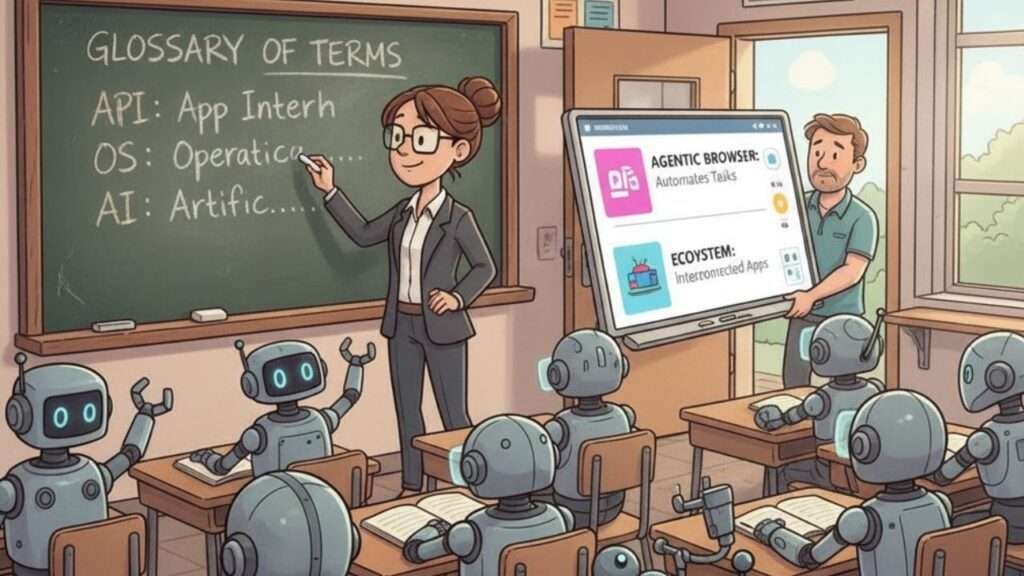
1. AI (Artificial Intelligence): Technology enabling machines to perform tasks that typically require human intelligence, such as learning, problem-solving, and language comprehension.
2. Bolt-On Software: Specialized software designed to extend or complement the functionality of a core platform without replacing it.
3. BrowserOS: An open-source or proprietary browser-based meta-platform that treats the web as the runtime environment, hosting extensions, web apps, and AI agents across devices and operating systems.
4. Composable Enterprise: A business approach where companies assemble modular, best-of-breed software services integrated through APIs to maximize agility and adaptability.
5. Ecosystem: A connected network of software platforms, bolt-ons, developers, and users interacting to create collective value.
6. GPT (Generative Pre-trained Transformer): Advanced AI language model architecture developed by OpenAI, serving as a platform for creating specialized AI-powered applications.
7. Integration Fatigue: User frustration and inefficiency caused by managing and coordinating multiple disconnected software applications or bolt-ons.
8. OEM (Original Equipment Manufacturer): The primary producer of hardware or software platforms for which bolt-ons create supplementary functionality.
9. Platform: A software environment enabling development, distribution, and integration of bolt-ons or extensions to augment capabilities.
10. Predictive Maintenance: AI-driven techniques used to predict equipment failures before they happen, often implemented via specialized bolt-on software.
11. UX (User Experience): Overall perception and satisfaction a user has when interacting with software or a platform.
12. API (Application Programming Interface): A set of rules and protocols allowing software components to communicate and interoperate.
13. Plug-In: A software component that adds a specific feature or service to an existing computer program.
14. Extension: A lightweight software module that enhances browser or platform capabilities without altering core functionality.
15. Meta-Platform: A platform that hosts other platforms or ecosystems, acting as a universal environment.
16. Agentic Browser: Advanced browsers that integrate AI to interpret, summarize, and act on web content, providing interactive user experiences.
17. Workflow: A sequence of processes through which work passes from initiation to completion within software or business operations.
18. Data Privacy: Principles and policies protecting user data confidentiality and controlling its usage.
19. Vendor Fragility: Risks associated with reliance on software providers that may face acquisition, shutdown, or operational disruption.
20. Platform Politics: Market dynamics where dominant vendors influence integration rules, access, and partner treatment within ecosystems.
21. Digital Nervous System: Metaphor for AI’s role as an underlying infrastructure coordinating digital activities seamlessly.
22. Open Source: Software with publicly accessible source code that can be freely used, modified, and shared.
23. Machine Learning: A subset of AI where systems improve automatically through experience and data analysis without explicit programming.