

Rebranding A Nation Via The G.R.E.A.T Framework.
Disclaimer.
This article is for informational and educational purposes only and does not constitute professional, legal, or financial advice.
The views expressed are those of the author and do not represent any official organization or government entity. Readers should not rely solely on this content for decision-making and should seek professional guidance where appropriate.
Article Summary.
The GREAT Framework for National Renewal offers a powerful storytelling tool for diagnosing national decline and guiding revitalization.
It highlights how national identity is critical not only to external reputation but also internal cohesion and hope.
The framework’s five decline stages demonstrate how nations lose their narrative and potential.
Conversely, the renewal stages provide a roadmap for reclaiming and rebranding national identity to foster resilience, innovation, shared values, self-determination and sustained effort.
This article underscores that national branding is more than image; it is the foundation for trust, collective pride and future success.
Top 5 Takeaways.
1. A nation’s brand is more than external perception; it shapes internal identity and collective will.
2. Decline results not just from economic loss but from the erosion of shared values, trust, and citizen engagement.
3. Renewal begins with recognizing existing grit and resourcefulness at the individual and community level.
4. Shared ethos and autonomy enable a nation to craft a self-determined path forward rooted in common values.
5. Tenacity and sustained collective effort are essential to translating potential into meaningful national progress.
Table of Contents.
1. Introduction: Branding Beyond Borders.
2. The Power of National Branding.
3. Introducing the G.R.E.A.T. Framework.
4. A Call to Reflection.
5. Conclusion.
6. Article Analysis.
1.0 Introduction: Branding Beyond Borders.
Think of a nation as a story told a million times over, in classrooms, on factory floors, across dinner tables and in the hearts of its people.
Every country has a brand, whether it designs one deliberately or not. That brand isn’t just a tourism slogan or an export label. It’s the emotional resonance that shapes how the world sees you, and more importantly, how you see yourself.
National identity matters. It influences everything from international trade negotiations to whether a young graduate decides to stay or leave.
It affects whether citizens feel pride when their flag appears on screen, or whether they change the channel. Reputation isn’t vanity, it’s the foundation of trust, cohesion, and collective possibility.
But here’s the question that haunts many nations today: What happens when a once-great national brand loses its way? When the story being told no longer matches the story being lived?
2.0 The Power of National Branding.
Countries have long understood the power of a compelling brand. Britain reimagined itself as “Cool Britannia” in the 1990s, celebrating creativity and innovation.
New Zealand positioned itself as “100% Pure,” leveraging its pristine landscapes to attract both tourists and high-value industries.
“Made in Japan” transformed from a post-war punchline into a global seal of quality, technological excellence and forward thinking.
These aren’t just marketing campaigns. They’re frameworks that shape perception, influence trade, attract talent and guide diplomatic relationships.
A strong national brand opens doors. A weak one closes them.
Yet the most powerful effect of national branding is often overlooked: what it does internally. A compelling national story doesn’t just attract outsiders, it galvanizes insiders.
It gives citizens a shared narrative, a reason to believe in collective effort, a sense that their individual contributions matter to something larger.
When that story rings true, it becomes self-fulfilling. When it rings hollow, it becomes corrosive.
3.0 Introducing the G.R.E.A.T. Framework.
What follows is a framework for understanding national identity through two lenses, decline and renewal. The acronym G.R.E.A.T. works both ways, like a coin with two faces. One side diagnoses what happens when a nation loses its narrative. The other prescribes how that narrative might be reclaimed.
This isn’t a political prescription or a policy manual. It’s a storytelling tool—a way for citizens, leaders, and communicators to examine their national story with fresh eyes. Because before you can rebrand anything, you have to understand what the current brand actually says.
3.1 The Decline: When a Brand Loses Its Soul.
G is for Grief.
There’s a particular kind of sadness that settles over communities when the factory closes, when the mine shuts down, when the young people leave and don’t come back. It’s not just economic loss—it’s identity loss. Towns built around a single industry don’t just lose jobs; they lose their reason for being.
This grief manifests in different ways. Sometimes it’s nostalgia, endless conversations about “the way things used to be.”
Sometimes it’s anger, looking for someone to blame. Sometimes it’s just a quiet resignation, a sense that the best days are behind and nothing ahead will ever match what came before.
When a nation experiences widespread decline, that grief becomes collective. People stop believing in the future because the present keeps betraying them.
The national brand, once associated with progress and possibility, becomes associated with loss. And loss, compounded over time, becomes an identity all its own.
R is for Regression.
Progress isn’t guaranteed. History shows us that nations can move backward just as easily as forward.
Expertise gets ignored. Innovation gets abandoned. The institutions and industries that once drove advancement get dismantled or allowed to decay.
Sometimes regression happens slowly, a gradual outsourcing of capabilities, a quiet shift from making things to simply consuming them.
Sometimes it happens rapidly, when leaders choose comfort over courage, short-term gains over long-term vision.
The tragedy of regression is that it’s often disguised as something else. It gets framed as efficiency, or modernization, or necessary adaptation to global realities.
But underneath, it’s often just the path of least resistance, choosing what’s easy over what’s right, what’s cheap over what’s sustainable, what’s expedient over what’s excellent.
E is for Erosion.
Erosion doesn’t announce itself. It’s not dramatic. A bridge doesn’t collapse all at once, it rusts, slowly, year after year, inspection after inspection, until one day it’s no longer safe to cross.
The same happens with trust. With shared values. With the invisible infrastructure that holds a society together. Institutions that once commanded respect become targets of cynicism.
Leaders who once inspired become sources of disappointment. The social contract—that unspoken agreement about how we treat each other and what we owe to the collective—starts to feel like a relic from a more naive time.
Erosion creates a particular kind of brittleness. Everything still looks intact from a distance, but touch it and it crumbles. The foundation can no longer bear the weight it was designed to carry.
A is for Apathy.
When people stop believing their actions matter, they stop acting. Voter turnout drops. Community involvement dwindles. The civic muscles that once powered social change atrophy from disuse.
Apathy isn’t laziness, it’s learned helplessness. It’s what happens when effort repeatedly fails to produce results, when voices go unheard, when the system seems rigged or indifferent or both. People don’t disengage because they don’t care; they disengage because caring hurts too much when nothing changes.
This creates a vicious cycle. Apathy enables further decline, which breeds more apathy. The very people who could turn things around convince themselves—sometimes with good reason—that turning things around is impossible.
T is for Tragedy.
Here’s what makes national decline truly tragic: it’s rarely inevitable. Nations don’t fall because they lack resources or talent or potential. They fall because they make choices, collectively, that undermine their own success.
They ignore warnings from experts because the truth is inconvenient. They sacrifice long-term prosperity for short-term comfort. They divide when they should unite.
They outsource when they should invest. They forget the principles that made them great in the first place.
The tragedy isn’t the decline itself, it’s that decline was avoidable. The tools existed. The knowledge existed. The capability existed.
What failed wasn’t capacity; it was will. And that’s the hardest thing to confront: that the nation sabotaged itself, slowly, through a thousand small decisions that seemed reasonable at the time but, accumulated, led somewhere no one actually wanted to go.
3.2 The Rebrand: Reclaiming the G.R.E.A.T. Identity.
G is for Grit.
But here’s the thing about national identity: it’s not fixed. The same letters that spell decline can spell renewal, depending on how you read them.
Every nation that’s fallen on hard times once had something that got them through harder times before.
Call it determination. Resilience. The refusal to quit when quitting would be easier. Grit isn’t about never falling down—it’s about always getting back up.
That grit built things. It powered industries from nothing. It created communities in hostile environments. It turned setbacks into comebacks, again and again.
It’s the kind of quality that can’t be imported or outsourced, it has to come from within. The question isn’t whether the grit still exists.
It does, in the person working two jobs to keep their family afloat, in the entrepreneur launching a business against long odds, in the community organizer bringing neighbors together.
The question is whether that individual grit can become collective again, whether it can be channeled into something larger than personal survival.
R is for Resourcefulness.
Innovation doesn’t require permission. The greatest problem-solvers are often the ones with the least resources, because necessity doesn’t just mother invention, it demands it.
Resourcefulness is about making do with what you have, finding creative solutions to difficult problems, refusing to accept that “this is just how things are.” It’s the opposite of learned helplessness. It’s agency in action.
Nations that reclaim their resourcefulness stop waiting for someone else to solve their problems. They rebuild local manufacturing capacity.
They invest in homegrown talent. They create from scratch rather than consuming what others create.
This doesn’t mean isolation, it means capability. Being able to participate in the global economy from a position of strength rather than dependency.
E is for Ethos.
A nation without shared values is just a collection of people who happen to occupy the same geography.
Ethos is what transforms a population into a community—the moral compass that points the way forward, the principles that everyone, regardless of difference, can rally around.
Rebuilding ethos doesn’t mean everyone thinking the same way. It means everyone caring about the same things: that the nation should work for all its citizens, that future generations deserve better than the present, that excellence matters, that integrity isn’t negotiable.
Ethos creates the possibility of unity without uniformity. It’s the foundation for civic pride that includes rather than excludes, for patriotism that celebrates what is without ignoring what could be better.
A is for Autonomy & T is for Tenacity.
These last two belong together, because one without the other is incomplete.
Autonomy is about self-determination. It’s producing your own energy rather than depending on others for it. It’s manufacturing critical goods locally.
It’s about making decisions based on your own values and needs, not just reacting to forces beyond your control. Autonomy doesn’t mean isolation, it means having the capability to choose your own path.
Tenacity is what keeps you on that path even when it gets difficult. It’s the drive not just to survive, but to excel. To punch above your weight.
To set standards rather than just meet them. Tenacity turns potential into reality through sustained effort over time.
Together, autonomy and tenacity form a powerful combination. They say: We control our destiny, and we won’t stop until we achieve something remarkable.
4.0 A Call to Reflection.
Every nation is telling a story, whether consciously or not. That story lives in policy decisions and popular culture, in what gets celebrated and what gets ignored, in the opportunities available and the constraints imposed.
The question each nation faces and each citizen within it, is whether that story is one worth telling. Whether it reflects who you actually are or who you’ve settled for being. Whether it inspires the next generation or warns them to leave.
Rebranding a nation isn’t about marketing or slogans. It’s about looking honestly at the story you’re currently telling and deciding whether it’s the story you want to tell.
It’s about recognizing that national identity isn’t handed down from on high—it’s created collectively, through millions of individual choices that add up to something larger.
You are the brand stewards of your nation’s future. The story isn’t finished. The next chapter hasn’t been written yet.
What will it say?
5.0 Conclusion.
National renewal begins with understanding the powerful story a nation tells itself and the world. The GREAT Framework reveals how decline and renewal stem from collective choices that shape a nation’s identity.
While decline manifests through grief, regression, erosion, apathy, and tragedy, renewal arises from grit, resourcefulness, ethos, autonomy, and tenacity.
This dual lens empowers leaders and citizens alike to confront hard truths and collectively reclaim a national narrative that inspires unity, pride and purposeful action. The future of a nation is not predetermined; it is a story written daily by its people. The challenge is to ensure it is a story worth telling.
6.0 Article Analysis.
6.1 The Intent Of This Article.
This article aims to provide a strategic and conceptual framework – GREAT – for understanding the trajectory of national identity and branding in times of decline and renewal.
It seeks to move beyond superficial marketing tactics to explore how a nation’s story shapes both external perceptions and internal cohesion.
Readers could potentially use this article to assess their national narrative and explore pathways for reclaiming a revitalized, shared identity that drives collective action and sustainable progress.
6.2 Why This Article Matters.
National identity and branding are foundational to a country’s global standing, economic opportunities, and social fabric.
I believe this article addresses a critical gap by linking the emotional and cultural dimensions of national branding with practical frameworks for renewal.
In contexts where many nations face socio-economic challenges, identity crises, and geopolitical shifts, the GREAT Framework foregrounds the importance of grit, resourcefulness, ethos, autonomy, and tenacity as core pillars.
Its relevance extends from public policy to grassroots movements, offering a timely guide in a world where national narratives increasingly influence diplomatic, economic, and social futures.
6.3 Bibliography (1) (Directly Relating to This Article).
1. Keith Dinnie, Nation Branding: Concepts, Issues, Practice – An in-depth exploration of nation branding theory and practical applications Link
2. Andy W. Hao et al., Two Decades of Research on Nation Branding: A Review and Future Research Agenda – A synthesis of nation branding research trends and themes Link
3. Andreja Sršen, The Aspects of National Branding: Conceptual and Theoretical Framework – Sociological and economic perspectives on nation branding Link
4. E. Avraham, Nation Branding and Marketing Strategies for Combatting National Stereotypes – Analysis of nation branding strategies Link
5. The Storytelling Power of Australian Manufacturing – Explores how industry narratives shape national pride and decline.
6. Marketing the Great Inland Shift for Australia – Examines geographic and economic repositioning as part of national renewal.
7. Revive the Aussie Spirit of the Good Old Days – Reflects on nostalgia and the need to transform grief into grit.
8. The Made in Australia Dream – Highlights autonomy and resourcefulness in national branding.
9. Marketing a Better Australian Future – Positions marketing as a tool for societal renewal.
10. Marketing-Leadership-Policy and Our Homelessness Crisis – Illustrates erosion of ethos and the need for collective renewal.
11. Australian Car Manufacturing – A case study of decline (Grief, Regression) and potential rebranding.
12. Standout Brand Identity – Foundational to the idea of nations as brands.
13. The Language of Marketing – Underpins the storytelling approach to national identity.
14. Research Based Marketing Solutions – Supports the analytical framework behind diagnosing decline.
15. Define Your Goals – Connects to renewal through clarity of purpose and autonomy.
6.4 Bibliography (2) (Conduct Further Research).
1. Simon Anholt, Competitive Identity: The New Brand Management for Nations, Cities and Regions – Foundational text on nation branding strategies
2. B. Boan, The Case for Marketing Strategy in International Relations – Examines the intersection of nation branding and international diplomacy Link
3. S. Hassan, Nation Branding: The Strategic Imperative for Sustainable Market Competitiveness – Discusses sustainability in nation branding Link
4. WIPO, Nation Branding: Beyond a Cosmetic Symbol – Insight on the broader impacts of nation branding beyond marketing Link
5. Public Diplomacy and Nation Branding articles in journals like International Marketing Review and Journal of Place Management and Development.
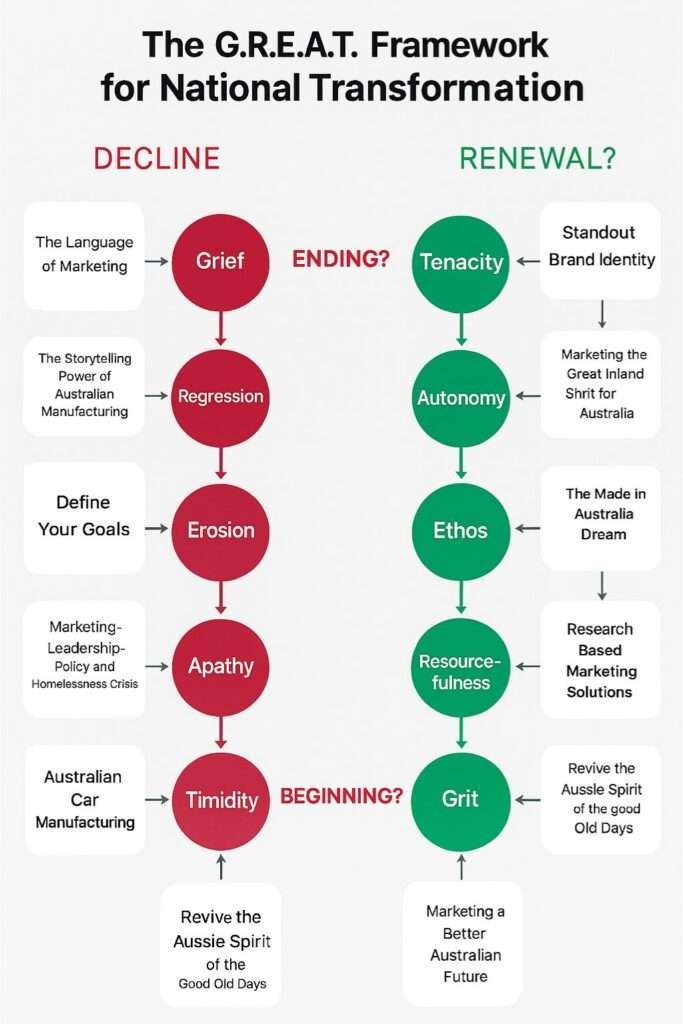




[…] The GREAT Framework for National Renewal – Provides a structured model for transforming nostalgia and collective grief into actionable […]
[…] reverse this erosion, the article refers to my version of the G.R.E.A.T. Framework (Narrative Renewal), which is a dual-purpose tool that diagnoses decline and prescribes restoration. It shows how grief […]